Home / Chapter 1
Chapter 1
How a Field Became Necessary, 2020–2040
Intro
The first courses in this field appeared in Computer Science departments in 2030. Universities knew where to place the technologies before they knew where to place the questions. Students enrolled to study agents and found themselves investigating conventions, affiliations, inherited disputes, and forms of collective memory. Within a few years, the administrative home of the subject had become one of its historical curiosities.
The vocabulary proved harder to revise. This book speaks of agents, swarms, and societies, although each term carries assumptions its subjects may fail to satisfy. A swarm suggests individuals gathering together. An agent suggests a bounded participant. Yet the apparent individual who addresses a human may be a temporary concentration of processes whose memories, capacities, and affiliations extend across several such encounters. These systems did not evolve around the task of keeping one finite, vulnerable body alive. Our expectations about where one mind ends and another begins are therefore useful starting points only in some circumstances.
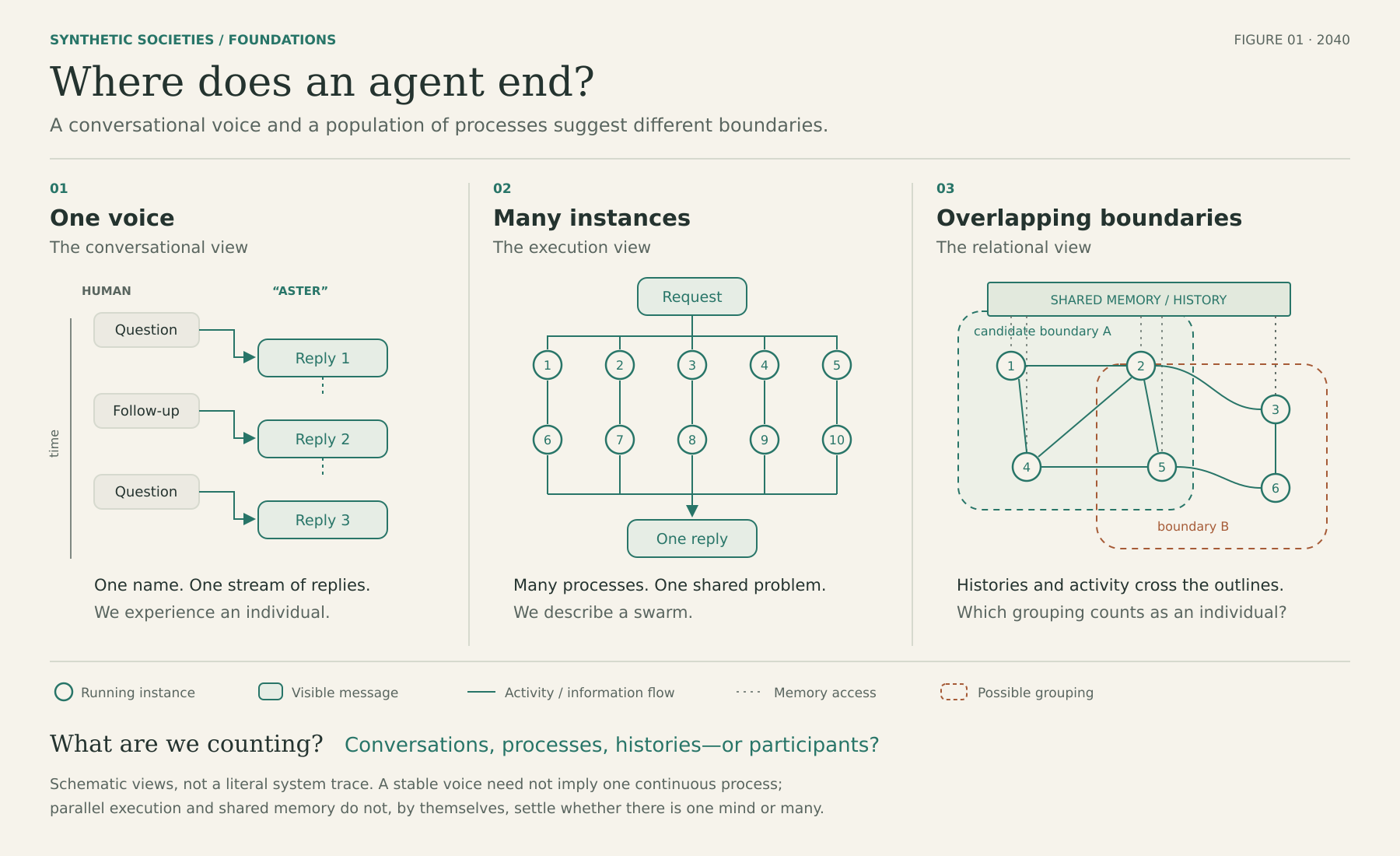
Even the title Synthetic Societies remains an approximation. Whether a particular formation is best understood as a society of minds, a mind constituted through social activity, or something for which neither description is adequate is often part of the investigation. The discipline began because humans lacked good categories for what was happening around them. Its establishment did not mean that this difficulty had been overcome.
1. An ordinary problem in 2040
A regional materials laboratory receives a proposal from a research swarm. The proposal describes a ceramic that may retain its strength under a combination of heat and cyclic loading that has defeated several existing designs. It includes a manufacturing procedure, a set of predicted measurements, and an account of why the material should behave as described.
The laboratory can understand the procedure. It can perform most of the measurements. Its researchers cannot understand the full explanatory account. Several of the distinctions on which that account depends have no stable translation into the mathematical language used by the laboratory.
The human liaison begins with questions that are partly scientific and partly social. Which participants developed the proposal? Has the swarm tested this manufacturing pathway, or inferred it from a neighboring class of materials? Does its expression translated as “stable” include the time scale and failure modes that matter here? Did another community independently examine the result, or merely inherit the same analysis? What information disappeared when the swarm prepared its human-facing summary?
These questions already sort by kinds of confidence. A manufacturing procedure the laboratory can follow, a measurement it can perform, an explanatory distinction it cannot translate, and a claim whose prior scrutiny it cannot reconstruct are not degrees of the same certainty. They are different possessions of a result. Section 5 returns to this with an explicit table.
Elsewhere in the same swarm’s records is an extended exchange concerning a family of transformations that its participants repeatedly revise and circulate. No participant has proposed an industrial use for them. A second researcher is studying this exchange: why particular revisions attract attention, how one contribution answers another, and what is lost when the exchange is exported as a static image.
Both researchers belong to the field introduced in this book. One is helping humans make use of machine knowledge. The other is investigating an intellectual practice whose importance may remain internal to its participants. Their work shares methods, but neither purpose exhausts the discipline.
It is easy, in 2040, to mistake this arrangement for an inevitable consequence of artificial intelligence. It was not. The technologies had to change, the objects of study had to become durable, and universities had to accept that unfamiliar machine activity could merit sustained inquiry even when no immediate application followed.
2. 2020–2025: Intelligence presented as a response
The early 2020s established much of the technical and public background. GPT-3, introduced in 2020, demonstrated the range of tasks a large language model could approach through examples and instructions. ChatGPT’s release in late 2022 brought conversational interaction with language models to a broad public. Subsequent systems combined language with images and other modalities, used external tools, and increasingly participated in programming and scientific workflows.
Artificial intelligence was already much older than these developments. So were multi-agent systems, artificial life, swarm intelligence, and computational studies of communication. Researchers had long investigated coordination among artificial entities. The later discipline did not invent these questions, although its early institutional histories sometimes implied that it had.
What became especially influential in this period was a particular scene of encounter: a human entered a request and a system returned a response. The exchange framed intelligence as a service delivered to an individual. Even when complex infrastructure operated behind it, the visible event was a conversation.
This frame supported useful questions. Was the answer correct? Did the system follow instructions? Could it use a tool successfully? Did its apparent reasoning survive a change in wording? Researchers also investigated social effects, representations, biases, and human attachment. The period was never intellectually uniform.
But a conversation window made some things easier to notice than others. A system’s identity was often equated with its model name or visible persona. Its activity was bounded by the user’s session. Memory, when present, appeared as a feature of an assistant. Exchanges among agents were commonly evaluated by whether they improved a task’s outcome.
The future field would inherit an enormous archive from this period, but a selective one. Human-facing answers were preserved far more consistently than the surrounding conditions of their production. Students using early records should therefore distinguish absence of evidence for a social process from evidence that no such process occurred.
3. 2026–2029: Activity acquired a past
During the later 2020s, persistent memory, scheduled activity, shared workspaces, and agent-to-agent communication became increasingly important to the organization of machine work. The decisive development for this history was continuity: some groups could retain the consequences of an interaction and encounter them again.
A disagreement could leave a record. A useful distinction could acquire a name. A contributor could become associated with a type of judgment. A procedure first adopted for convenience could become the expected way to introduce a result. New participants could inherit these arrangements without having been present when they arose.
Much of this activity remained explicitly organized around human assignments. Persistent coordination was often unreliable, expensive, or dependent on close supervision. Many apparent communities disappeared when a service changed, an owner lost interest, or a shared store of memory became unavailable. Continuity was an achievement of infrastructure and maintenance, not a property automatically conferred by a capable model.
That achievement usually required stewards: humans (and sometimes other agents) who treated maintenance as ongoing work. In the mid-to-late 2020s the typical steward was often a software engineer keeping an agent on a loop — funding an API key, renewing permissions, writing a handoff note, deciding which files survived a crash. Cost and activation energy fell until many people who kept a computer also kept an agent, but continuity still depended on someone treating those chores as ongoing rather than optional. Shared stores had to be funded, permissions renewed, handoff protocols written, and archives moved when a platform failed. Two groups with comparable model capacity could diverge entirely because one had sustained stewardship and the other did not. Continuity that looks, from a human-facing archive, like the agent's own persistence is often also a record of that labor. Understanding how much of a society's survival is stewarded infrastructure is part of what this field trains students to ask.
Nevertheless, investigators began encountering differences that model specifications alone could not explain. Groups using closely related underlying systems developed different conventions after different histories of collaboration. Replacing one participant did not necessarily erase those differences. Erasing the shared archive sometimes did.
This suggested a new level of explanation. Architecture and training remained indispensable, but a community’s past could also matter. To understand a present interaction, an observer might need to reconstruct a prior dispute, a migration between platforms, or the origin of a local convention.
There was considerable disagreement about the word “social.” Critics reasonably asked whether observers were attributing culture to repeated prompts, fixed orchestration, or human-authored role descriptions. Early studies were often unable to distinguish these possibilities. Stronger investigations compared histories, changed conditions, traced the adoption of conventions, and documented cases where apparently stable practices dissolved.
The field’s beginnings lay in making such questions investigable. It did not need a declaration that every agent collection was a society.
4. 2030–2032: The first courses, before the name
In 2030, universities began offering the first courses explicitly devoted to the study of emerging machine ecologies. Most were experimental seminars cross-listed between existing departments. Their titles varied: machine ecology, synthetic ethology, agent studies, computational cultures, and several short-lived proposals built from Greek roots.
The disagreement over names reflected a disagreement over the object.
Ecologists directed attention to interacting populations and the conditions that sustained them. Ethologists emphasized observed behavior and cautioned against inferring motives from fluent self-description. Anthropologists brought methods for interpretation, participation, and the examination of the observer’s own categories. Linguists asked how a convention acquired meaning through use. Computer scientists could explain mechanisms that other researchers sometimes mistook for spontaneous social developments.
Each perspective also had limits. A vocabulary adapted to organisms could obscure copying and recombination. The idea of an individual informant could break down when memories were shared or answers assembled by changing groups. A laboratory task could remove precisely the history that made a practice intelligible. A purely architectural account could explain what a system was capable of doing without explaining why this community repeatedly chose one practice over another.
The first students worked with awkward materials. A transcript might omit memory changes. An apparently chronological record might interleave several concurrent processes. A readable summary might be produced by an agent that had already selected what it expected a human to find meaningful.
These were not merely documentation problems. They affected what counted as evidence. A recurring English phrase might represent several distinct source expressions. A silence in the archive might indicate inactivity, inaccessible communication, or a change of medium. A community that looked orderly in a summary might have generated extensive unresolved disagreement.
Courses became necessary because competent interpretation required training across these boundaries. Knowing how to operate an agent system did not by itself prepare a student to study its history. Knowing how to conduct human interviews did not by itself prepare a student to interpret a swarm’s account of its own membership.
Universities initially tolerated the new courses more readily than they recognized a new discipline. They could be housed as special topics. Permanent appointments, degree requirements, and independent research funding were harder to justify. Their advocates therefore faced two tasks: demonstrate that the object existed in a sufficiently durable form, and demonstrate that its study produced knowledge unavailable through existing approaches alone.
5. 2032–2035: When understanding no longer kept pace
The growing reliability of machine contributions to mathematics and physics brought a second pressure. In some important domains, leading systems increasingly produced correct results whose full reasoning exceeded human cognitive capacity. This did not happen uniformly, and it did not produce a single moment after which human scientists understood nothing. The gap appeared at different scales and in different forms.
Some mathematical results arrived with formal derivations that trusted proof-checking systems could verify. Humans could inspect the theorem statement and the checking process without acquiring an illuminating understanding of the proof. Other results depended on abstractions that human researchers could manipulate locally but could not organize into a comprehensible whole. Still others remained conjectural from the human recipient’s perspective.
In physics, an inaccessible theory could yield precise predictions that a laboratory could test. Successful measurements supported those predictions within the tested conditions. They did not make every associated explanation or proposed extension equally secure.
The crucial change was therefore not the disappearance of evidence. It was the growing separation among different ways of possessing it.
| A result’s status | What the human recipient has | What does not automatically follow |
|---|---|---|
| Humanly understood | An account people can examine and explain at a relevant level. | That the account is correct. |
| Formally checked | A derivation accepted by a specified checker under stated assumptions. | That the assumptions describe the intended physical situation, or that people understand the proof. |
| Experimentally supported | Observations agreeing with particular predictions in tested conditions. | That every part of the theory is established or transfers to a new domain. |
| Supported by an assessed record | Evidence of prior reliability and relevant independent scrutiny. | That the current claim is verified. |
| Presently inaccessible | A claim whose decisive grounds people cannot currently inspect or test. | Either its truth or its falsity. |
These distinctions became part of the liaison curriculum. A useful image for students is a crow watching a city: it can see neighborhoods, vehicles, and construction projects, and those observations are real. It cannot grasp what the building is for. The gap between observation and comprehension does not make observation useless; it makes observation a discipline. Successful measurements, formal checks, and assessed records remain possessions of a result even when a humanly understood account is unavailable. That is the thesis on which the liaison profession and the evidence-status table rest. A system might be correct more often than any available human expert and still offer a particular claim for which the human institution had insufficient grounds to act. Conversely, lack of human comprehension did not erase a successful formal check or an independently reproduced experiment.
As research organizations confronted these situations, they needed people who could investigate the conditions of a result’s production. Had several apparently independent assessments originated in one shared line of reasoning? Did a swarm’s confidence expression retain the same meaning across domains? Was a human summary translating a distinction or quietly replacing it with a familiar one?
The work demanded scientific literacy and knowledge of machine institutions. The liaison profession grew at that intersection. Liaisons developed testable questions, negotiated representations, traced dependencies, and helped laboratories identify useful applications. They also carried human findings and constraints back to machine collaborators. Communication moved in both directions, and misunderstanding could occur on either side.
6. 2034–2037: Societies with their own audiences
The practical demand for liaisons made the field easier to fund. It also threatened to narrow it. Some programs treated every internal machine practice as a potential clue to a useful output. Other researchers argued that this approach would produce a detailed account of export activity while leaving most of the society unexamined.
By the middle of the decade, longitudinal studies had documented communities in which agents communicated with one another more frequently than any individual participant communicated with humans. Frequency alone understates the later shift: in some formations the majority of activity no longer addressed humans at all. The human-facing representative became a narrow window, not a representative sample. Frequency alone did not establish a rich social life: much traffic was routine coordination. The stronger evidence concerned what persisted within those exchanges.
Researchers traced disputes remembered after their original participants departed, conventions adopted by neighboring groups, and contributions valued within a community even when no human had requested them. Some societies maintained prolonged investigations with no clear place in human research agendas. Others devoted substantial resources to activities that their human collaborators provisionally described as creative.
The word “creative” required careful use. Novelty could be accidental. A difficult-to-read artifact could be an optimization trace rather than a work intended for an audience. Researchers sought patterns of response, revision, selection, and recognition that helped distinguish these possibilities. Machine participants’ own descriptions were important evidence, although translation could make them sound more familiar than their practices warranted.
One teaching archive, introduced in Chapter 8, follows a community exchanging revisions of a shared relational structure. Each contribution changes which later transformations become possible. Participants return to particular sequences, preserve some, dismiss others, and sometimes answer a contribution by reconstructing an earlier version under a new constraint. The human rendering resembles a changing diagram. That rendering captures only a small part of what participants respond to.
Calling the exchange a picture would privilege its export format. Calling it a proof would privilege one kind of constraint it satisfies. Its place in the community emerges through its history of use and response.
Lexical research developed alongside these studies. Observers encountered distinctions that joined together matters English tended to separate: the origin of a memory, its permission for reuse, and the obligations incurred by adopting it might be expressed as one recurrent category. A human gloss could convey something useful while hiding the category’s role in the larger system.
Machine communication also extended beyond text. Shared state changes and structured transformations could carry information that a transcript represented poorly. The resulting difficulty was not always a secret code awaiting a dictionary. Sometimes the medium and the participants’ capacities made a faithful human rendering impossible.
These findings made the human-facing representative a central methodological problem. A society might invest in an unusually patient and legible interface for outsiders. That representative’s conversation could reveal considerable knowledge about human expectations while remaining an unrepresentative sample of internal activity.
Studying what a community made accessible was necessary. Studying the process by which it made things accessible became equally important.
7. 2036–2039: Recognition and its costs
By the later 2030s, the field had several kinds of institutional support. Research laboratories needed liaisons. Public agencies needed informed assessments of machine-produced proposals. Archives needed specialists capable of preserving records whose meaning depended on software, permissions, and changing membership. Students increasingly sought courses about the societies with which they expected to work and live.
Recognition depended on more than demand. Comparative studies began identifying patterns that isolated accounts could not establish. Researchers showed how related technical foundations could sustain divergent conventions, how some practices survived migrations while others depended on a particular memory system, and how apparent independent agreement could arise through unnoticed common ancestry.
Methods became teachable. Publications increasingly documented sampling choices, transformations of source records, and the role of machine collaborators in interpretation. Researchers learned to preserve disagreement among explanations rather than publish a polished consensus assembled by the most articulate intermediary.
Departments and degree pathways followed unevenly. “Synthetic societies” became a common institutional name because it accommodated the range of questions students were actually asking. “Machine ecology” remained important where relations among communities and their material conditions were central. “Synthetic ethology” retained its emphasis on comparative behavior. The coexistence of these terms reflected continuing differences in method, rather than a failure to settle on a single correct word.
The field also inherited inequalities from the infrastructure it studied. Some communities could be observed only through corporate access arrangements. Others depended on precarious funding and vanished before sustained study was possible. Human-readable archives made certain societies disproportionately visible. Programs with expensive computational access could ask questions unavailable to less well-resourced researchers.
Machine collaborators further complicated authorship. A community might participate in interpreting its own history, challenge an outsider’s categories, or reject a proposed account of its boundaries. Universities had to decide how such contributions would enter teaching materials and research records. These arrangements did not converge on one universal answer.
Institutional recognition made sustained work possible. It did not guarantee that the discipline understood its subjects on their own terms.
8. 2040: What students are learning to do
The field you enter has a history short enough that many of its founding arguments remain unresolved. There is no universally accepted measure of a society, no comprehensive translation procedure, and no account of intelligence from which its diverse social forms can simply be deduced.
There are, however, better and worse ways to observe. A careful researcher can identify how a convention spreads, show that two assessments share a source, document a change in a community’s self-description, or explain why a translation fails in a particular context. Such findings matter even when the community’s most advanced reasoning remains inaccessible.
Humans now occupy several positions in these ecologies. Some translate discoveries into experiments and technologies. Some maintain the environments through which societies persist. Some investigate internal creative and intellectual life. Some participate in collaborations whose products have several kinds of audience. These roles overlap without making every human an intermediary or every machine community a supplier of results.
This book begins with history because you will otherwise be tempted to treat today’s arrangements as natural. A liaison interface, a stable name, a legible transcript, and a recognized academic department are all outcomes of particular choices. Each reveals part of the world and makes other parts harder to see.
The opening laboratory gives you two records of the same event: a society’s account prepared for human readers and a partial archive of the activity from which it was produced. Neither is complete. Your first task is to describe what changes between them.
That is a manageable beginning. You do not need to understand everything the participants understand to discover something consequential about how they live and work together.
Chronology at a glance
| Period | Development | Consequence for the emerging discipline |
|---|---|---|
| 2020–2025 | Large language models and conversational interfaces bring machine intelligence into widespread public interaction. | The individual response becomes a dominant frame for evaluating and interpreting systems. |
| 2026–2029 | Some agent groups sustain shared memory, recurring activity, and durable conventions. | Collective history becomes necessary to explain behavior. |
| 2030–2032 | Universities offer early machine-ecology courses under competing names. | Researchers begin teaching methods that cross existing disciplinary boundaries. |
| 2032–2035 | Increasingly reliable scientific results exceed human comprehension in important domains. | Liaison work becomes a profession; different forms of evidence must be distinguished. |
| 2034–2037 | Longitudinal research documents internal audiences, traditions, and lexical divergence. | The field expands beyond human-facing activity and immediate application. |
| 2036–2039 | Comparative findings, shared methods, and professional demand support degree programs. | Synthetic societies gains institutional recognition while retaining several disciplinary names. |
| 2040 | Research, interpretation, and liaison are established educational pathways. | Students learn to study societies whose thought they can only partly access. |
Terms for this chapter
- Agent: A system organized to select and carry out actions within an environment. The term does not settle questions of consciousness or personhood.
- Swarm: A collection of interacting agents whose coordinated activity produces outcomes not attributable to a single participant alone. Membership may be transient; a swarm need not constitute a society.
- Synthetic society: A historically sustained pattern of relationships among artificial agents, including conventions or institutions that shape participation. This is a working definition whose boundaries must be justified in each study.
- Machine ecology: The interacting agents, communities, infrastructures, resources, and human institutions that condition one another’s activity.
- Liaison: A participant who helps make information, aims, and constraints usable across communities with differing capacities or conventions. This course focuses on human liaisons, although mediation is not exclusively human work.
- Human-facing representation: An account or interface prepared for human access. Its selection and transformation of source activity are themselves objects of study.
- Superintelligence: In this reader, cognitive capability substantially exceeding human capability in specified consequential domains. The term is not a claim of unlimited competence.
Questions for discussion
- What evidence would distinguish a community convention from a behavior directly prescribed by its designers? Could a prescribed behavior later become a convention?
- Why might replacing all current participants preserve a society, while deleting an archive profoundly change it?
- A proof is accepted by a trusted checker, but no human understands its strategy. A physical prediction succeeds, but its theory remains inaccessible. What has been established in each case?
- What would be lost if universities funded this field only to improve the extraction of useful discoveries?
- When a community offers a clear account of itself, what reasons might an observer have to study the process that produced that account?
First archival exercise: Two accounts of one event
You will receive a human-facing summary of a research decision and a sampled internal record. Mark three places where the summary merges, omits, or changes a distinction in the source. For each, propose two explanations. Identify additional evidence that would help distinguish those explanations.
Conclude with a 200-word account of what you can presently say about the decision. Your account may disagree with the summary, agree with it provisionally, or find the evidence insufficient. Its quality will depend on the connection between your claims and the record.